
When your BMW or Mercedes AC is not blowing cold, it can quickly turn a comfortable drive into an uncomfortable one, especially during hot weather. Many drivers assume the problem is simply low refrigerant, but an air conditioning system has several components that can cause warm or weak airflow when something goes wrong.
BMW & Mercedes AC not blowing cold can be caused by low refrigerant, leaks, compressor problems, cooling-fan issues, clogged filters, or electrical faults that require proper diagnosis.
A BMW or Mercedes uses a sophisticated climate-control system that may include electronic controls, sensors, compressors, condensers, evaporators, cooling fans, and refrigerant circuits. Because these systems are more complex than basic air conditioning systems, diagnosing the actual cause is important before replacing expensive components.
In this guide, we will explain the common causes of AC problems in BMW and Mercedes vehicles, the warning signs to look for, potential repair costs, and when you should have your vehicle professionally inspected.
Why Is My BMW or Mercedes AC Not Blowing Cold?
There are several reasons your BMW or Mercedes may stop producing cold air. Some problems are relatively simple, such as a dirty cabin air filter or low refrigerant. Others may involve the compressor, condenser, electrical system, or climate-control module.
The most common causes include:
- Low refrigerant
- Refrigerant leaks
- Faulty AC compressor
- Damaged condenser
- Failed cooling fan
- Clogged cabin air filter
- Faulty blower motor
- Bad temperature sensor
- Climate-control electrical problems
- Restricted airflow
- Faulty expansion valve
- Evaporator problems
Identifying the correct cause is important because adding refrigerant without fixing an underlying leak may only provide a temporary improvement.
1. Low AC Refrigerant
One of the most common reasons a BMW or Mercedes AC system does not blow cold is low refrigerant.
Your vehicle’s air conditioning system depends on refrigerant to absorb heat from the cabin and release it outside the vehicle. When the refrigerant level becomes too low, the system may not be able to produce properly cooled air.
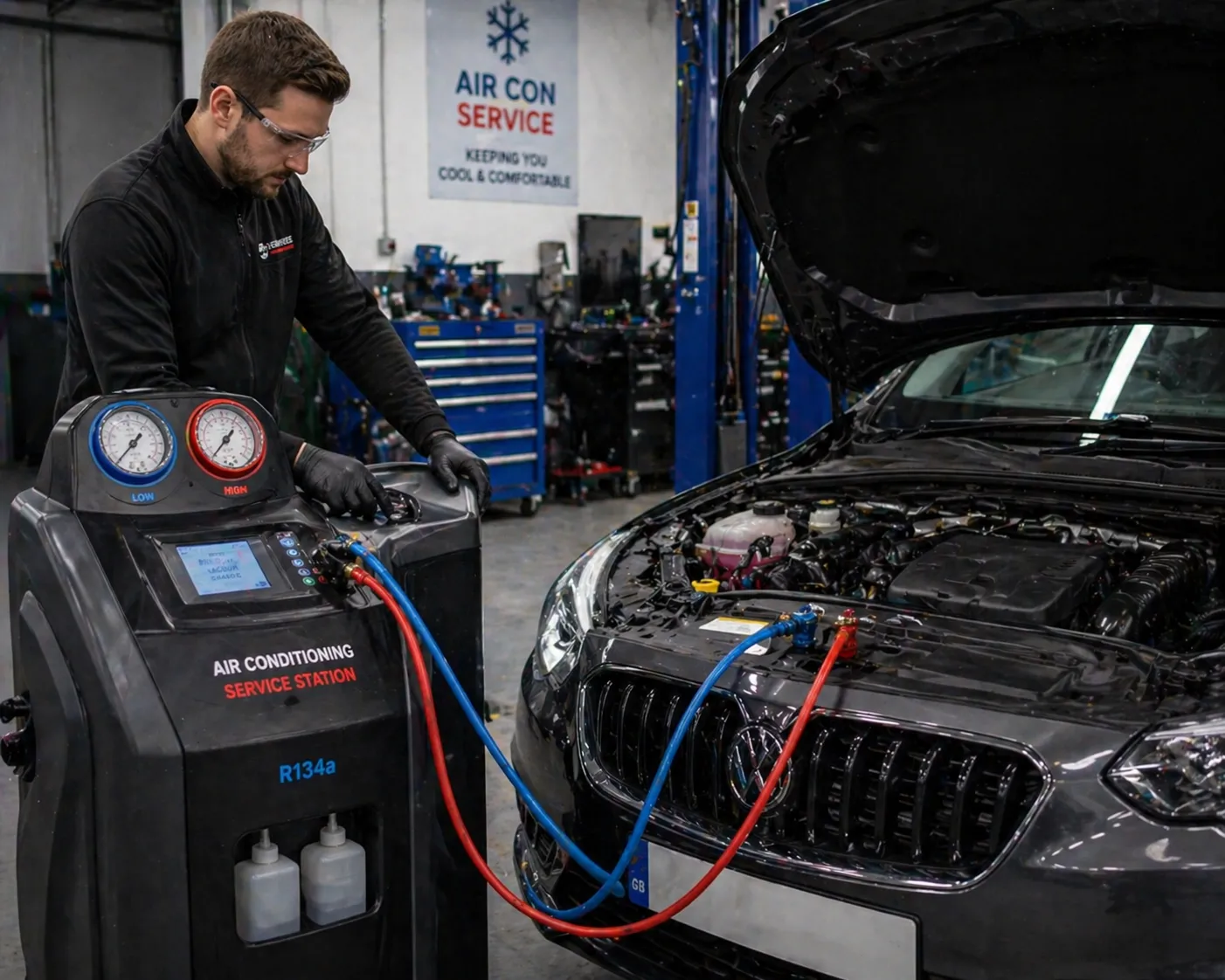
You may notice:
- AC blowing slightly cool instead of cold
- Warm air after driving for a while
- AC performance changing with engine speed
- Compressor cycling frequently
- Longer cooling time
- Poor performance on extremely hot days
Low refrigerant usually indicates that refrigerant has escaped from the system. Refrigerant does not normally disappear simply because the vehicle is old.
A professional technician should check the system for leaks before recharging it.
2. Refrigerant Leak
A refrigerant leak is another major cause of BMW and Mercedes AC problems.
Leaks can occur in several locations, including:
- AC hoses
- O-rings
- Compressor seals
- Condenser
- Evaporator
- Service ports
- Refrigerant connections
Small leaks can be particularly difficult to identify because the AC may continue working for weeks or months before the refrigerant level becomes too low.
A technician may use specialized equipment, UV dye, electronic leak detection, or pressure testing to locate the source.
Simply recharging the AC without repairing the leak can result in the same problem returning.
3. Failed or Weak AC Compressor
The AC compressor is one of the most important components in your BMW or Mercedes air conditioning system.
It circulates refrigerant through the system and helps create the pressure difference required for cooling.
A failing compressor may cause:
- Warm air from the vents
- Unusual noises
- Poor cooling at idle
- AC that works intermittently
- Grinding or rattling sounds
- Compressor clutch problems on applicable systems
Modern BMW and Mercedes vehicles can use electronically controlled compressor systems, which means diagnosing the problem may require more than simply checking whether the compressor turns on.
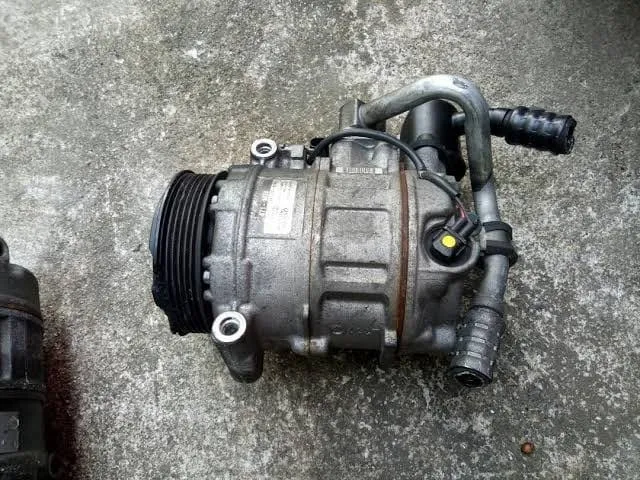
A compressor should not automatically be replaced until the rest of the system has been properly tested.
4. Damaged AC Condenser
The AC condenser helps remove heat from the refrigerant after it leaves the compressor.
Because the condenser is located toward the front of the vehicle, it can be exposed to road debris, dirt, corrosion, and physical damage.
A damaged or restricted condenser may cause:
- Warm AC
- Poor cooling at low speeds
- Excessive system pressure
- Refrigerant leaks
- Reduced AC efficiency
If the condenser has developed a leak, it may need replacement rather than simply being recharged.
5. Cooling Fan Problems
Your BMW or Mercedes depends on proper airflow across the condenser to remove heat.
If the electric cooling fan is not operating correctly, the AC may become noticeably warmer, particularly when the vehicle is sitting in traffic or idling.
A common pattern is:
Cold while driving + warm at idle = possible airflow or cooling-fan problem.
However, this symptom can have multiple causes, so proper diagnosis is necessary.
A technician may check the fan motor, wiring, control module, fuses, and related sensors.
6. Dirty or Clogged Cabin Air Filter
Not every AC problem is caused by the refrigerant system.
A dirty cabin air filter can restrict airflow through the vents. Your AC may technically be producing cold air, but you may not feel enough of it inside the cabin.
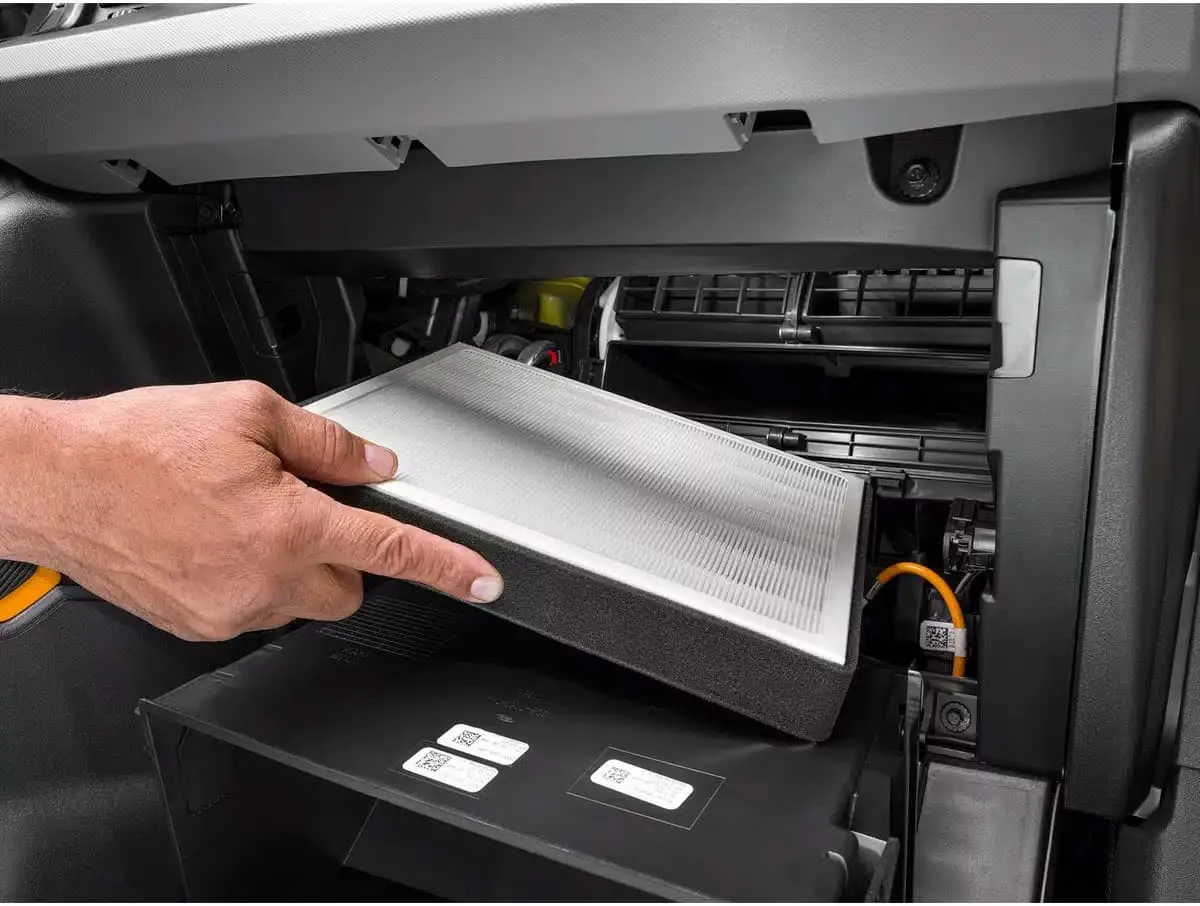
Symptoms can include:
- Weak airflow
- Reduced ventilation
- Musty smell
- Dust coming from vents
- Reduced windshield defogging performance
- Poor cabin comfort
BMW and Mercedes vehicles have cabin filtration systems designed to help keep dust and contaminants out of the passenger compartment.
Replacing a clogged cabin air filter is generally much simpler than repairing an AC compressor or condenser, so it should be one of the basic checks during an AC diagnosis.
7. Faulty Blower Motor
The blower motor pushes conditioned air through the vehicle’s vents.
If the blower motor is failing, you may experience little or no airflow even though the AC system itself is cooling properly.
Possible symptoms include:
- Weak airflow
- No airflow
- Fan working only at certain speeds
- Intermittent blower operation
- Unusual noises behind the dashboard
The blower motor resistor or electronic blower control module can also cause fan-speed problems.
Because BMW and Mercedes vehicles can use electronically controlled blower systems, diagnostic testing is often useful.
8. Faulty Temperature Sensor
Modern BMW and Mercedes climate-control systems rely on multiple sensors to determine cabin temperature and regulate cooling.
A faulty sensor can provide incorrect information to the climate-control system.
For example, if a sensor incorrectly reports that the cabin is already cold, the system may reduce cooling even though the cabin is still hot.
Potential symptoms include:
- Inconsistent temperature
- AC switching between warm and cool
- One temperature setting behaving differently from another
- Climate control not responding correctly
- Unexpected changes in fan speed
A diagnostic scan can help identify sensor or climate-control faults.
9. Climate-Control Electrical Problems
BMW and Mercedes vehicles contain sophisticated electrical and electronic systems. An AC problem may sometimes be related to a fuse, wiring issue, control module, sensor communication problem, or software-related fault.
Potential electrical causes include:
- Blown fuse
- Damaged wiring
- Faulty relay
- Climate-control module problem
- Sensor communication issue
- Compressor control problem

This is one reason why replacing parts based only on symptoms can become expensive.
A professional diagnostic scan can help determine whether the problem is mechanical, refrigerant-related, or electronic.
10. Faulty Expansion Valve
The expansion valve regulates refrigerant flow into the evaporator.
If the expansion valve becomes restricted or fails to regulate refrigerant correctly, the AC system may not cool properly.
Symptoms can sometimes include:
- Poor cooling
- Uneven cooling performance
- Incorrect refrigerant pressures
- Frost or unusual temperature changes
- AC performance that changes unexpectedly
Because expansion-valve problems can produce symptoms similar to other AC failures, pressure readings and system testing are important before replacing the component.
11. Evaporator Problems
The evaporator is located inside the vehicle and plays an important role in removing heat from cabin air.
Because it is typically located behind the dashboard, diagnosing or replacing an evaporator can be more involved than replacing easily accessible components.
An evaporator problem may involve:
- Refrigerant leaks
- Poor cooling
- Unusual odors
- Moisture-related issues
- Reduced AC performance
If an evaporator leak is suspected, professional leak testing is recommended.
12. AC System Contamination
The air conditioning system needs the correct refrigerant and lubricant to operate properly.
If the system has been serviced incorrectly or contaminated with unsuitable materials, cooling performance can suffer.
Contamination can potentially affect:
- Compressor operation
- Expansion valve
- Refrigerant pressures
- Cooling performance
- System reliability
This is why it is important to have BMW and Mercedes AC systems serviced with the correct equipment and procedures.
Why BMW & Mercedes AC Problems Can Be More Complicated
BMW and Mercedes vehicles often use advanced climate-control technology.
Depending on the model and year, the system may include automatic temperature regulation, multiple sensors, electronically controlled components, separate temperature zones, and sophisticated diagnostic systems.
For example, a vehicle may appear to have a simple “cold air” problem, while the actual fault could involve an electronic control signal or sensor.
This means that guessing and replacing parts can become expensive quickly.
A proper diagnosis should ideally identify the root cause before major components are replaced.
What Should You Check When Your AC Stops Blowing Cold?
If your BMW or Mercedes AC is not cold, start by observing exactly what the system is doing.
Check 1: Is There Air Coming From the Vents?
If there is strong airflow but the air is warm, the issue may involve refrigerant, compressor operation, condenser performance, or temperature regulation.
If airflow is weak, investigate the cabin filter, blower motor, or airflow restrictions.
Check 2: Does It Get Colder While Driving?
If the AC becomes colder at higher speeds but warmer when stopped, the cooling fan or condenser airflow may need to be checked.
Check 3: Is the AC Completely Warm?
Completely warm air can be caused by several problems, including low refrigerant, compressor problems, electrical faults, or control-system issues.
Check 4: Are There Strange Noises?
Grinding, squealing, rattling, or unusual clicking sounds may indicate a mechanical problem.
Check 5: Does One Side Feel Colder?
On vehicles with dual-zone or multi-zone climate control, uneven temperatures may point toward a blend-door, sensor, actuator, or climate-control issue.
Can You Drive a BMW or Mercedes With the AC Not Working?
In many cases, a vehicle can still be driven if the AC is not producing cold air. However, that does not necessarily mean the problem should be ignored.
If the AC problem involves the compressor or another component connected to the belt-driven system, continuing to drive may potentially cause additional mechanical problems depending on the vehicle design and failure mode.
You should pay attention to:
- Unusual noises
- Burning smells
- Warning lights
- Overheating
- Belt problems
- Sudden changes in engine behavior
If you notice any of these symptoms, have the vehicle inspected as soon as possible.
How Much Does BMW or Mercedes AC Repair Cost?
The cost of repairing a BMW or Mercedes AC system depends heavily on the actual problem, vehicle model, parts required, and labor involved.
A basic cabin air filter replacement may be relatively inexpensive, while replacing an AC compressor, condenser, evaporator, or other major component can cost significantly more.
Common factors affecting repair cost include:
- Vehicle model and year
- OEM vs. aftermarket parts
- Labor time
- Refrigerant type
- Leak location
- Compressor condition
- Electrical diagnosis
- Additional damaged components
The best approach is to diagnose the problem first and then receive an estimate based on the actual repair required.
Why You Should Not Just Add More Refrigerant
Many drivers assume that adding refrigerant will automatically solve an AC problem.
Sometimes a recharge can restore cooling if the system simply needs the correct refrigerant charge, but low refrigerant may be a symptom of a leak.
If refrigerant is leaking from the system, adding more refrigerant without repairing the leak does not solve the underlying problem.
Overcharging can also cause problems.
For this reason, AC service should involve checking the system’s condition and using the correct refrigerant and service procedures for the specific vehicle.
When Should You Get Your BMW or Mercedes AC Inspected?
You should consider an AC inspection if you notice:
- AC blowing warm air
- Weak airflow
- Strange AC noises
- AC cooling intermittently
- AC becoming warm at idle
- Unusual smells
- Uneven cabin temperatures
- Fogging or moisture problems
- Compressor-related noises
Getting the problem checked early may help prevent a smaller issue from becoming a more expensive repair.
Professional BMW & Mercedes AC Diagnosis
European vehicles often require specialized knowledge and diagnostic equipment.
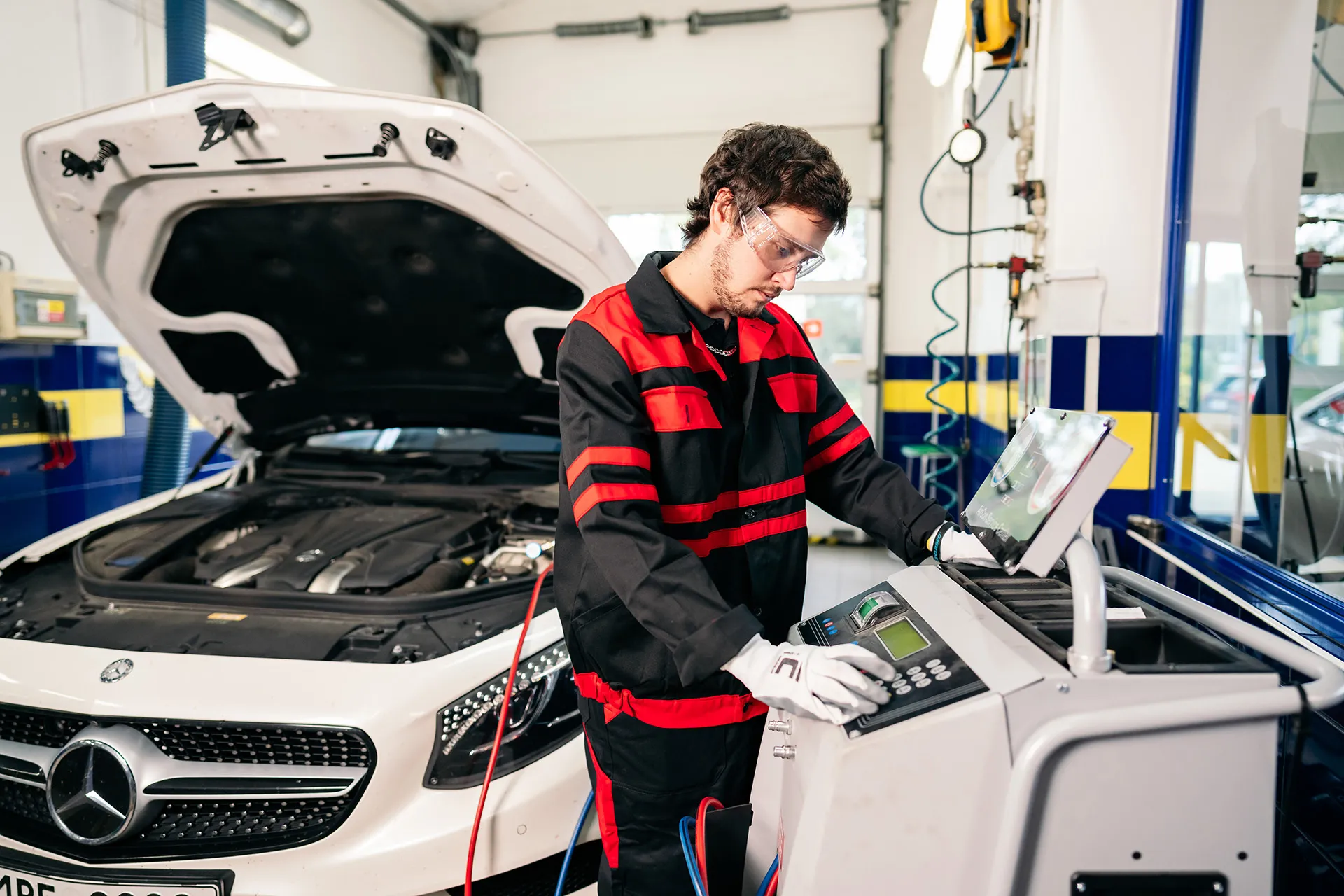
A technician familiar with BMW and Mercedes systems can evaluate refrigerant pressures, compressor operation, electrical signals, sensors, airflow, and climate-control components.
Instead of replacing parts based on symptoms alone, professional diagnosis can help determine why the AC is not blowing cold.
This is particularly important when the vehicle has an intermittent problem.
How to Prevent BMW & Mercedes AC Problems
Regular maintenance can help keep your climate-control system working properly.
Replace the Cabin Air Filter
Follow the maintenance recommendations for your specific vehicle and replace the cabin filter when necessary.
Use the AC Regularly
Using the air conditioning system periodically can help keep its components operating properly.
Address Strange Noises Early
Do not ignore unusual compressor or belt-related noises.
Check for Leaks
If refrigerant levels repeatedly become low, have the system inspected for leaks.
Use the Correct Refrigerant
Always use the refrigerant specified for your particular vehicle.
Choose Qualified European-Car Service
BMW and Mercedes systems can require model-specific diagnostic procedures, so choosing a technician familiar with European vehicles can be beneficial.
BMW vs. Mercedes AC Problems: Are They the Same?
BMW and Mercedes both use advanced air conditioning systems, but the exact design varies considerably by model and year.
A BMW 3 Series does not necessarily use the same system as a BMW X5, just as a Mercedes C-Class does not necessarily use the same AC components as a Mercedes GLE.
Therefore, the diagnosis should be based on the vehicle’s:
- Model
- Year
- Engine
- Climate-control configuration
- Refrigerant specification
- Specific fault symptoms
Avoid assuming that the same repair applies to every BMW or Mercedes.
Frequently Asked Questions
Why is my BMW AC not blowing cold air?
Common causes include low refrigerant, refrigerant leaks, compressor problems, condenser issues, cooling-fan failure, clogged cabin filters, sensor problems, and climate-control electrical faults.
Why is my Mercedes AC blowing warm air?
A Mercedes AC system can blow warm air because of low refrigerant, leaks, compressor problems, condenser or fan issues, faulty sensors, or electronic climate-control faults. Proper diagnosis is needed to identify the exact cause.
How do I know if my BMW AC needs refrigerant?
Weak cooling, warm air, and inconsistent AC performance can indicate low refrigerant, but these symptoms can have other causes. A technician should check refrigerant pressure and inspect the system for leaks before recharging it.
Why is my AC cold while driving but warm at idle?
This can be related to condenser airflow or cooling-fan operation, although other issues can produce similar symptoms. A professional inspection can determine the actual cause.
How often should BMW and Mercedes AC systems be serviced?
There is not one universal service interval for every BMW or Mercedes. Follow your vehicle’s maintenance recommendations and have the system inspected whenever cooling performance changes.
Can a dirty cabin filter make the AC feel warm?
A clogged cabin filter can significantly restrict airflow, making it feel as though the AC is not working properly. Replacing the filter may improve airflow, although it will not fix a refrigerant or compressor problem.
Is an AC refrigerant leak serious?
A refrigerant leak should not be ignored. It can reduce cooling performance and may eventually prevent the AC system from operating correctly. Finding and repairing the leak is better than repeatedly adding refrigerant.
How much does it cost to fix BMW or Mercedes AC?
The cost varies depending on the vehicle and failed component. A filter replacement may be relatively inexpensive, while compressor, evaporator, condenser, or electrical repairs can cost considerably more.
Final Thoughts
If your BMW or Mercedes AC is not blowing cold, do not immediately assume that the system only needs refrigerant. Low refrigerant, leaks, compressor problems, condenser damage, cooling-fan issues, clogged filters, sensors, and electrical components can all affect AC performance.
The most important step is identifying the root cause before replacing expensive parts.
If your European vehicle’s AC is blowing warm, cooling inconsistently, producing unusual noises, or showing other warning signs, having the system professionally diagnosed can help you understand what needs to be repaired and avoid unnecessary part replacement.
For BMW and Mercedes owners, timely diagnosis and proper maintenance can help keep the climate-control system reliable and your driving experience comfortable throughout the year.